

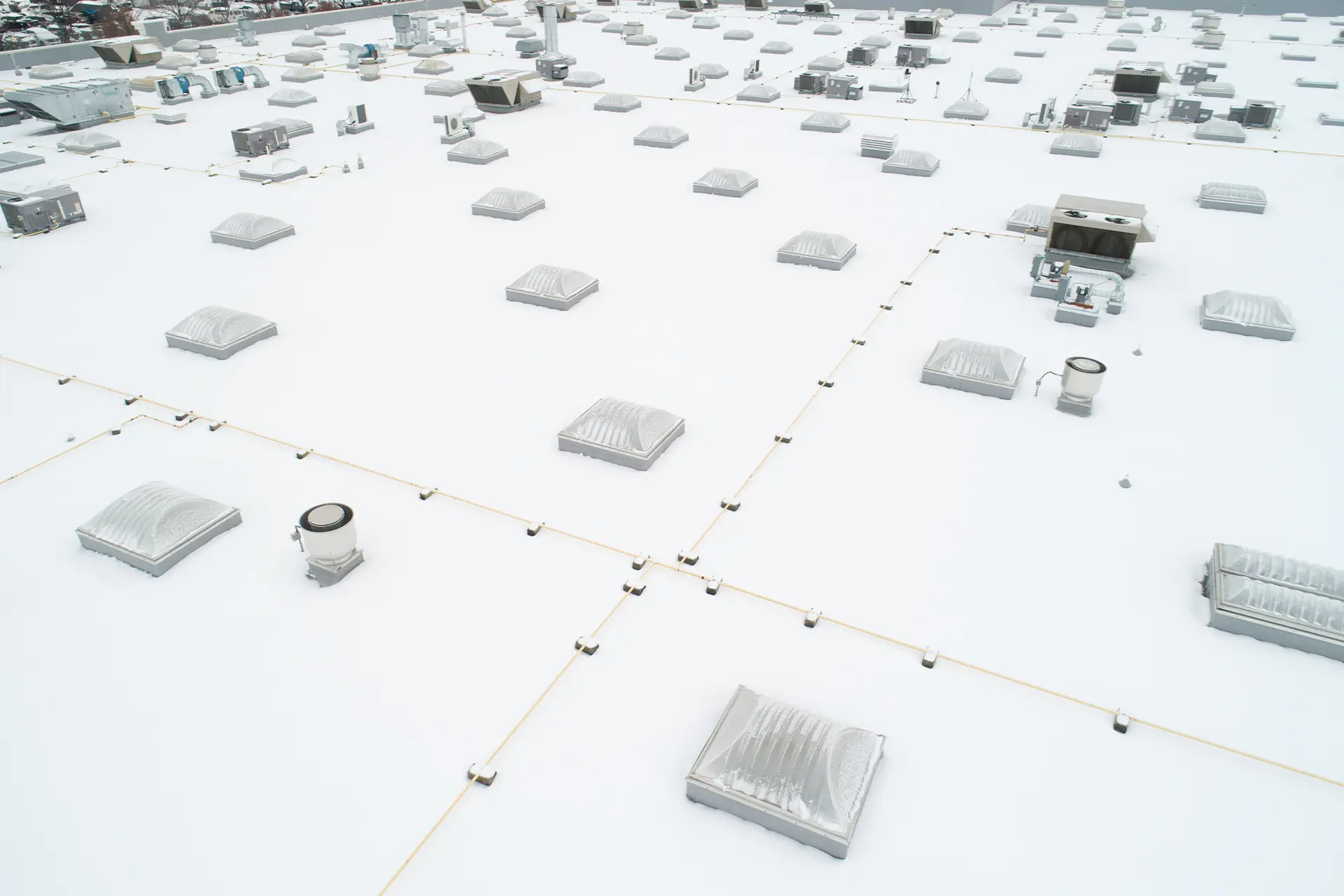
Flat roofing is common on commercial buildings because the roof surface can be used efficiently for equipment and drainage design. Several materials are used on flat and low-slope commercial roofs, and each has different strengths, limits and maintenance needs. The right choice depends on the building’s structure, use, climate, budget and what is already on the roof.
Anderson Industrial Roofing, family owned since 1993 with more than 30 years of experience, works on commercial roofs including single-ply systems (TPO, PVC and EPDM), metal roofing and coatings. The other systems below are included so owners can recognize what they have and ask better questions. To talk through your roof, call (866) 949-8016.
EPDM (Ethylene Propylene Diene Monomer)
EPDM is a synthetic rubber membrane known for durability and weather resistance. It is lightweight and flexible and tolerates a wide range of temperatures. Because it is a sheet product, seams and flashing details are important areas to check as it ages. Anderson’s single-ply membrane page covers EPDM alongside TPO and PVC.
TPO (Thermoplastic Olefin)
TPO is a single-ply membrane made from polypropylene and ethylene-propylene rubber. It is known for UV resistance and reflectivity, and it is commonly available in white. Seams are heat-welded, so weld quality at seams and details matters. Products vary by manufacturer, so ask for the specific membrane and thickness being quoted.
PVC (Polyvinyl Chloride)
PVC is another single-ply membrane with heat-welded seams. It is often used on commercial buildings and is known for chemical resistance and durability. Where roofs receive exhaust, grease or other chemicals from the building, material compatibility is worth confirming with the manufacturer.
Modified Bitumen
Modified bitumen is asphalt modified with polymers and installed in layers. It can be applied by torch-down, self-adhering or cold-applied methods. It provides good waterproofing, but torch application brings fire-safety requirements, and laps and flashings are common leak points as it ages.
Built-Up Roofing (BUR)
Built-up roofing layers asphalt and reinforcing fabrics to create a waterproof surface, often finished with gravel. It is a traditional system with a long track record. The gravel surface can hide damage, and repairs depend on knowing how many layers are present.
Green Roofs
A green roof places a living vegetation layer over a waterproofing membrane. It can add insulation and reduce stormwater runoff, but it needs more maintenance and structural support than other systems. Leaks can be harder to trace beneath the planting layer, so access to the waterproofing layer is part of the design discussion.
Spray Polyurethane Foam (SPF)
SPF is sprayed as a liquid that expands into a seamless, insulating foam. It is typically protected with a coating, so both coating condition and potential damage to the foam beneath deserve attention during inspection. Wear, punctures and ponding water can expose the foam, so periodic checks matter.
Metal Roofing
Metal is less common on truly flat roofs, but metal systems can be used in low-slope applications when the panel profile and seam design suit the slope. Metal reflects sunlight and is durable, but seams, fasteners and sealants at details need periodic attention. See Anderson’s page on metal roof installation.
Material Comparison: What to Verify and Where Problems Show
Use this table to see how each system is assembled, what an owner should verify, and the limitations that tend to appear on aging roofs. It is a general guide, not a recommendation for any specific building.
| Material | How it is assembled | What to verify | Limitations seen on aging roofs |
|---|---|---|---|
| EPDM | Rubber sheet; seams commonly taped or adhered; attachment may be ballasted or mechanical | Seam and flashing condition; punctures; shrinkage at edges | Open seams, loose flashing, ponding at low spots |
| TPO | Single-ply sheet; seams are heat-welded | Quality of weld at seams and details; membrane thickness and manufacturer product line | Seam separation, cracking at flashings, surface wear |
| PVC | Single-ply sheet; seams are heat-welded | Compatibility with nearby materials and exhaust grease or chemicals | Seam or flashing failure, brittleness at details |
| Modified bitumen | Layered asphalt sheets; torch-applied, self-adhered or cold-applied | Fire-safety needs for torch work; number of plies; surface granule loss | Blistering, ridging, splits at laps |
| Built-up roofing (BUR) | Alternating asphalt and reinforcing fabric, often with gravel | Weight, age, and whether the gravel hides damage | Blisters, alligatoring, exposed felts |
| Green roof | Vegetation and growing media over a waterproofing layer | Structural capacity, drainage, and access to the waterproofing for leak tracing | Leaks that are hard to locate under the planting layer |
| SPF | Sprayed foam, usually with a protective coating on top | Coating condition and thickness; foam condition under the coating | Coating wear, punctures, blisters |
| Metal (low slope) | Panels with seams and fasteners; standing seam systems | Panel profile and slope suitability; seam and fastener detailing | Open seams, loose fasteners, sealant failure at details |
Practical Observations for Owners
- Know what you have: Building records, past invoices or warranty paperwork often name the roof system. If they do not, a contractor can identify it during an inspection.
- Watch the inside signs: Ceiling stains, damp insulation or musty odors indicate water has entered, though not where. The roof above needs to be inspected to locate the source.
- Track ponding: Water that stays on the roof after rain points to drainage or slope problems that affect every system.
- Keep records: Photos from each inspection, repair and storm make later decisions easier.
- Leave roof access to professionals: Roof surfaces carry fall risks and can be damaged by foot traffic.
How a Contractor Assesses a Flat Roof
- Identifies the existing system and the number of layers.
- Inspects seams, flashing, penetrations, drains and surface condition.
- Checks for ponding and evidence of trapped moisture, using moisture-detection methods where warranted.
- Documents findings with photos and notes.
- Explains the options, including repair, restoration or replacement, and what each would include.
When to Take the Next Step
Schedule a professional on-site roof evaluation and estimate when leaks recur, ponding persists, seams or flashing are visibly open, a storm has hit, or the roof is approaching the end of its expected life. If the roof is dry and sound, a commercial roof coating may be an option after checking adhesion, membrane compatibility and drainage. Otherwise, repair or replacement may be the better path.
Frequently Asked Questions
Which flat roofing material is best for a commercial building?
There is no single best material. The choice depends on the building’s structure, use, climate, budget and the condition of the existing roof.
How can I tell what type of flat roof I have?
Check building records or warranty paperwork first. If they are unavailable, a roofing contractor can identify the system during an inspection.
Are TPO, PVC and EPDM the same?
No. They are all single-ply membranes, but they differ in composition, seam method and performance characteristics. TPO and PVC seams are heat-welded, while EPDM seams are typically taped or adhered.
Can a metal roof be used on a flat roof?
Metal can be used on low-slope roofs when the panel profile, seam design and slope suit the application. Ask the contractor which system is appropriate for your slope.